
Resonance: A Plague Tale Legacy Gameplay Explained
The core gameplay loop
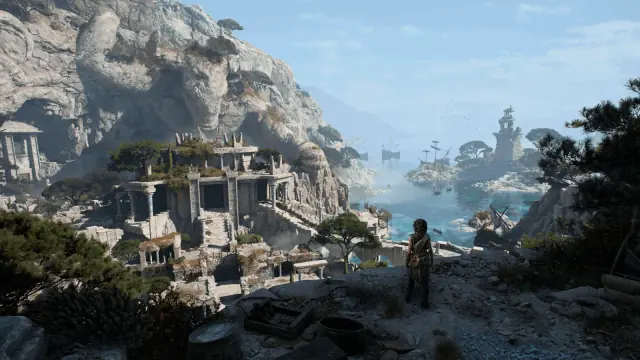
A typical stretch of Resonance moves from exploration and notebook clues into a fight or environmental mechanism, then back to traversal. Ruins, light sources, and visual trails frequently explain the next interaction. The route is linear, but checking side spaces still matters for collectibles and for understanding which tool the current room expects.
- Explore Crete and its ancient ruins.
- Fight with Sophia’s blades, using parries and counters.
- Read environments and solve light-based mechanisms.
- Follow the story across medieval and Minoan timelines.
How combat changes the series
Attack readability drives the combat layer. Regular blows can be blocked, yellow attacks call for a perfect parry, and red attacks normally require a dodge. Throwables build stagger, a critical strike punishes a defenseless enemy, the grappling hook disrupts high-ground archers, and the Focus attack creates space when several soldiers close in.
The largest change is Sophia’s ability to meet enemies in direct melee combat. Reviews consistently describe Resonance as more action-led than Innocence or Requiem, though exploration, puzzles, and narrative progression remain central.
Read attacks before committing
The Minoan sphere develops across the story instead of performing one fixed trick. It reveals hidden symbols, carries and redirects light, later splits a beam into red, blue, and green targets, and can concentrate light against particular obstacles. That progression is why a beam solution from one chapter should not be treated as a universal puzzle answer.
- Regular attacks can be blocked, while a precise parry creates the better counter window.
- Yellow attacks require a perfect parry to avoid breaking through the guard.
- Red attacks normally require a dodge rather than a block or parry.
- Throwables, critical strikes, the grappling hook, and the Focus attack create space against groups.
Light puzzles and exploration
The dual timeline is both narrative and practical. Theseus’s Minoan-era actions and discoveries explain places Sophia reaches more than two thousand years later. Direct combat is not a solution to every danger: some creature sequences still require crouching to avoid a trail, breaking pursuit over gaps, hiding, or reaching a protected light source.
The stolen Minoan sphere captures and redirects light. Later variants can split a beam into red, blue, and green targets or concentrate light to clear obstacles. Exploration, notebook clues, and these environmental mechanisms make up much of the play outside combat.
Two eras, one progression path
The medieval and Minoan periods are not only background. The story moves between Sophia and Theseus, using actions and discoveries across the two eras to explain the island, the Macula, and the mechanisms Sophia encounters.
Stealth and chase sequences still matter
More direct combat does not make every threat sword-solvable. The shift to melee also keeps hiding, moving slowly to avoid leaving a trail, reaching light, and escaping a pursuing creature. The game changes the balance of the series rather than becoming a pure arena action game.
Sources
Evidence reviewed on August 28, 2026. Links open the source used for the claims above.